
ABOUT THE SHOW
Shotgun Players presents a surreal story of older love based on the works of playwright Charles Mee. Director Erika Chong Shuch and dramaturg Sarah Rose Leonard combed the expanse of Mee’s corpus of plays to create a new story that resonated. “I’ve been thinking about how the love stories of middle-aged and older adults–and I include myself in this category–are muted. Falling in love, being in love, maintaining love: it’s complicated, twisty, chaotic,” says Shuch. “I hope I continue to be baffled by how to love, because it means I’m still thinking about it, still trying for it, still rooting for it, still valuing it.”
American Playwright, historian, and author Charles Mee encourages theater-makers to use his words freely in their material. He does not hold copyrights or charge for licensing. He says, “I think of it almost the way historians think that the quotes they insert into their narratives are evidence of the world they are talking about. So texts from today prove that the piece is set in the world of today.”
Dramaturg Sarah Rose Leonard
CREATING THE FALL SHOW
Charles Mee is the legendary American playwright you’ve never heard of. He is a contemporary of Sam Shepard, Edward Albee, and Arthur Miller, who all broke open our ideas about theatrical structure, but Charles questioned the notion of structure altogether. If you ask him what story his plays tell he’ll often say “well it’s summer then spring, fall, winter, and summer again.” He allowed for his plays to be licensed by anyone, and allowed artists to produce his work in any type of way. This openness meant his work traveled far. Since the 1990s, his plays have been produced everywhere from the famed Festival d’Avignon in France to the Brooklyn Academy of Music to colleges across the country.
He grew up in Illinois, played football, contracted polio at age 14, and his father swore if his son could make it then he’d go to church every Sunday. He survived, his father went to church every Sunday, and Charles proceeded to move to NYC, zipping around Manhattan in a wheelchair, becoming a fixture of downtown theater in the 1990s and 2000s. He asked that his plays be populated by actors of different physicalities, race, genders, abilities – never writing a part for a specific type of actor.
The Fall Show takes its format from his wild stage directions, which often look like this:
”…Meridee enters
and watches the crowd from a distance
with a growing sense of horror
at human relationships.
Everyone now is holding their heads in their hands.
Music crashes in
James takes his head out of his hands,
gets up,
and
what the fuck
he dances solo
happy, even ecstatic.
and dances out…”
We mashed stage directions with sections from many of his plays, but mostly First Love, about two older people falling in love for the first time. Charles is now 87, and he won’t stop writing.
Director Erika Chong Shuch
THE FALL SHOW: a fantasia
Erika Chong Shuch
FROM THE DIRECTOR
And yet, there it is. Maybe I am hoping–no, longing–to be brave enough to be flawed and hungry and opinionated and stubborn and hopeful and afraid and powerful and horny and trying and, sometimes, very quiet. I think it is brave to fall into love. I hope I keep doing so for the rest of my life. These are the things I’m thinking about as we made The Fall Show.
Chuck wasn’t physically in the rehearsal room but he was with us every day; a kind of long-distance trust. It turns out you can build a play that way too: thread by thread, message by message. Maybe that’s fitting, for a writer who has always built his plays the same way: out of fragments that, put together, add up to a life.
Sometimes I’d get stuck and a little textmessage assignment would arrive— something like, “I’m thinking about you and what you’re doing, and how I’m more and more loving how theatre throws chunks of words into worlds of performance art and music and visual arts and dance and happenings and everything you do.”
I went back to this text a dozen times. Here was explicit permission—no, instruction— to make wildly, to trust the deep gut, to keep faith that the abstract means something. So I ran with the experiment, forever grateful that Chuck sent us into this forest, and that Shotgun Players gave us the extraordinary gift of building this from scratch.
Chuck tells a story about trees. I won’t give it away here, because I want the tree onstage now to hold multitudes, but in a recent text exchange I asked, “If the beginning of the story is the trunk, and the middle is the branches… how does the story end?” Those three pulsing dots didn’t stop for two minutes, and then…
“With millions of trees being who and how they are. And no oak tree feels it has to be like a pine tree — or even like another oak tree.”
We asked Chuck: What about this project made you excited? “
Just knowing you, Sarah Rose and Erika… made me super eager to see what you would make of things of mine. I’ve never heard of anyone taking my stage directions and making what they want of those — and then throwing in some texts from First Love?! What do I wish when I go to the theatre? Take me someplace I’ve never been before!”
WHAT I LIKE
playwright charles mee
My own work begins with the belief that human beings are, as Aristotle said, social creatures—that we are the product not just of psychology, but also of history and of culture, that we often express our histories and cultures in ways even we are not conscious of, that the culture speaks through us, grabs us and throws us to the ground, cries out, silences us.
I don’t write “political plays” in the usual sense of the term; but I write out of the belief that we are creatures of our history and culture and gender and politics—that our beings and actions arise from that complex of influences and forces and motivations, that our lives are more rich and complex than can be reduced to a single source of human motivation.
So I try in my work to get past traditional forms of psychological realism, to bring into the frame of the plays material from history, philosophy, insanity, inattention, distractedness, judicial theory, sudden violent passion, lyricism, the National Enquirer, nostalgia, longing, aspiration, literary criticism, anguish, confusion, inability.
I like plays that are not too neat, too finished, too presentable. My plays are broken, jagged, filled with sharp edges, filled with things that take sudden turns, careen into each other, smash up, veer off in sickening turns. That feels good to me. It feels like my life. It feels like the world.
And then I like to put this—with some sense of struggle remaining—into a classical form, a Greek form, or a beautiful dance theatre piece, or some other effort at civilization.
—Chuck Mee
This Is the World of Magritte
Charles Mee’s play First Love begins with the words:
“We are indoors and out at the same time.
This is the world of Magritte.
There is a tree.
A piano.
We hear birds singing.”
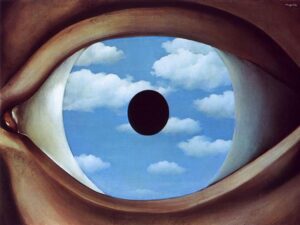
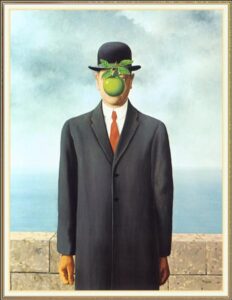
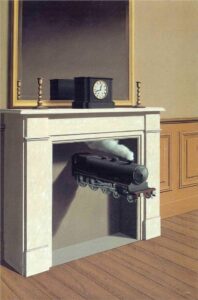
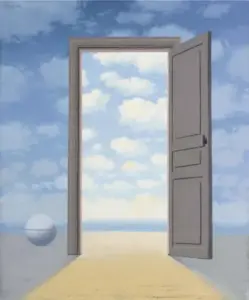
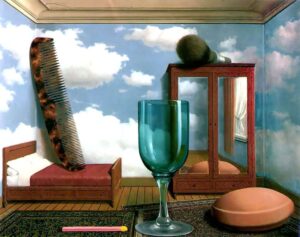
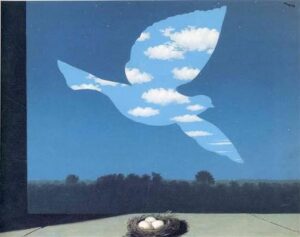
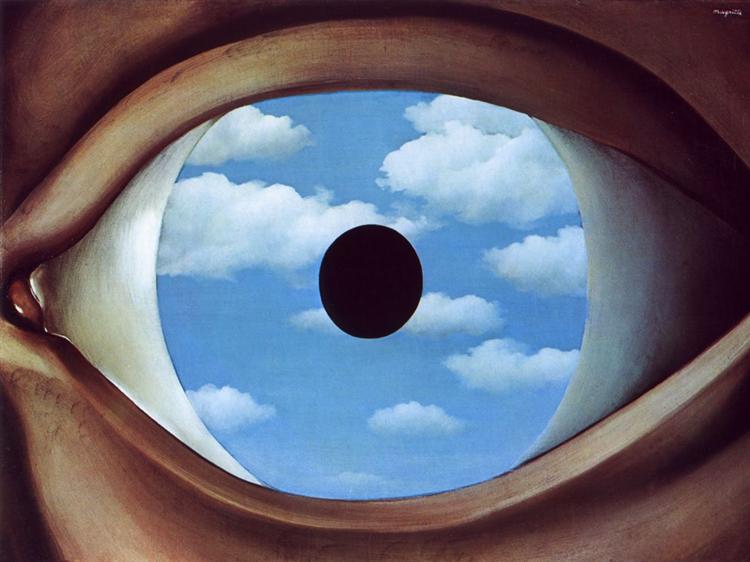
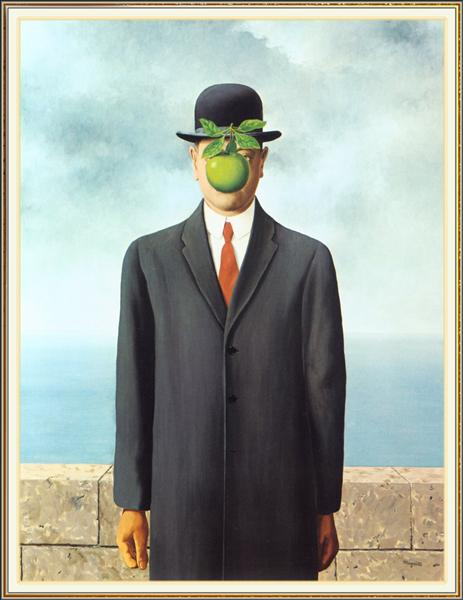
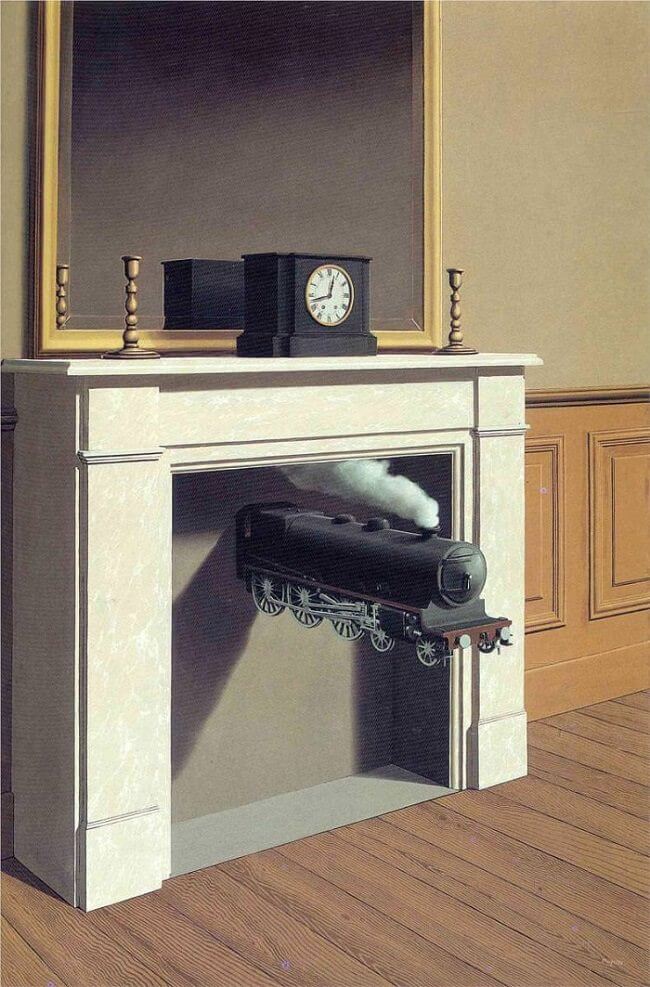
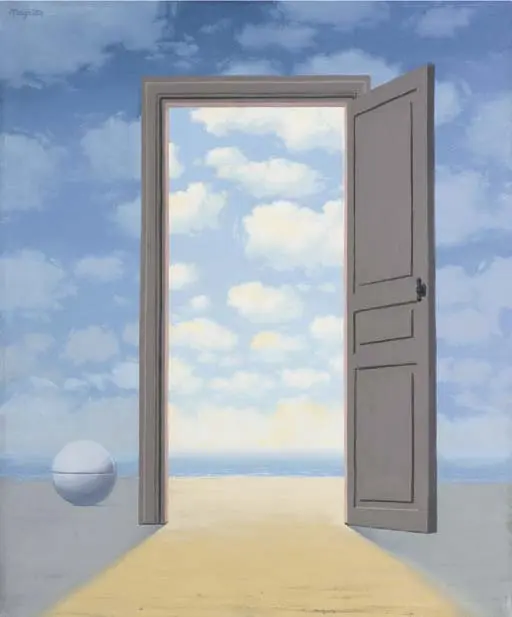
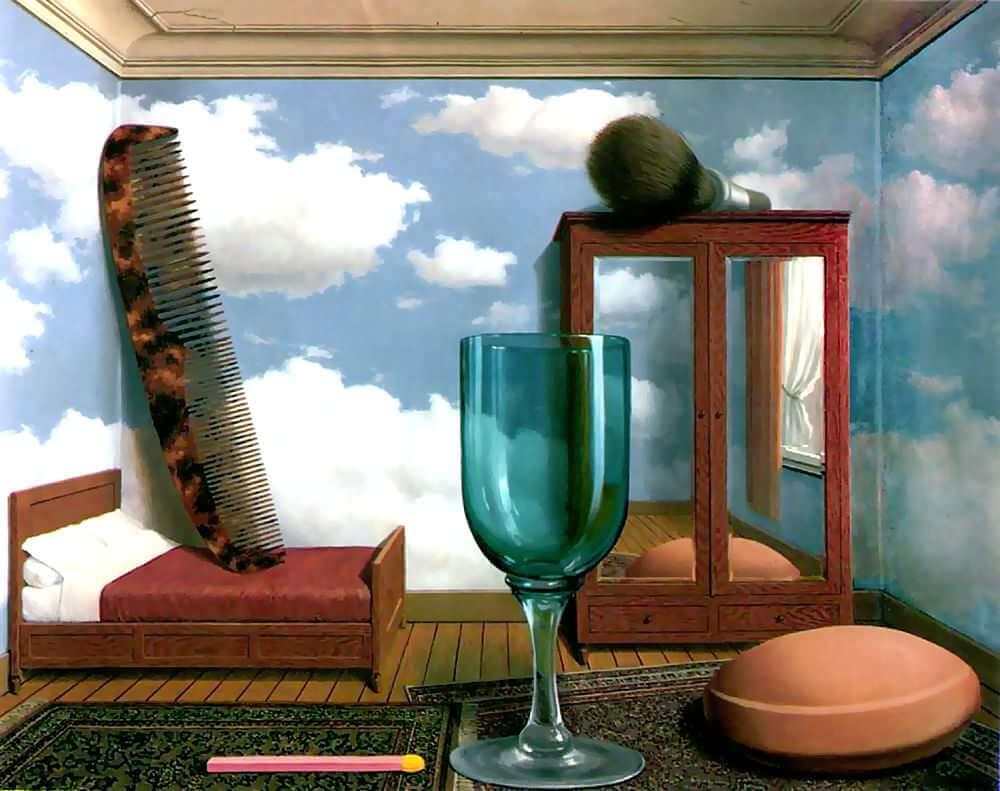
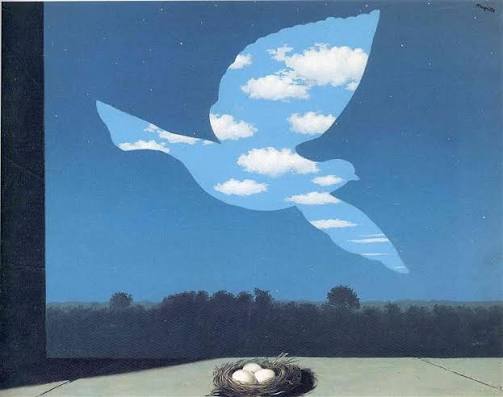
Sure, but also Chuck doesn’t remember writing half of this. It’s not because he’s 87 years old. It’s because his plays come from his subconscious. He thought of two older people falling in love for the first time in the world of the surrealist painter René Magritte. He thought of a stack of magazines, oldie songs, a striptease, an Allen Ginsberg poem, and some wild stage directions. The Fall Show places First Love in a world populated with an ensemble who bring Chuck’s imaginative stage directions to life, covering everything from falling to throwing to dancing to butt wagging. And in a few places, the ensemble create brief moments right out of Magritte paintings. See if you can find some of these images in the piece!

The Lovers (1928)
Thwarted desires are a common theme in Magritte’s work. Here, a barrier of fabric divides the intimate embrace of two lovers, transforming an act of passion into one of isolation and frustration. Some have speculated that the death of Magritte’s mother, by suicide, inspired a series of works in which he obscured his subjects’ faces. The artist was fourteen years old when her body was found in the River Sambre in Lessines, Belgium, with her wet nightgown purportedly wrapped around her face. Magritte disagreed with such interpretations, writing that meaning was elusive in his paintings: “‘What does it mean?’ It does not mean anything, because mystery means nothing either, it is unknowable.”
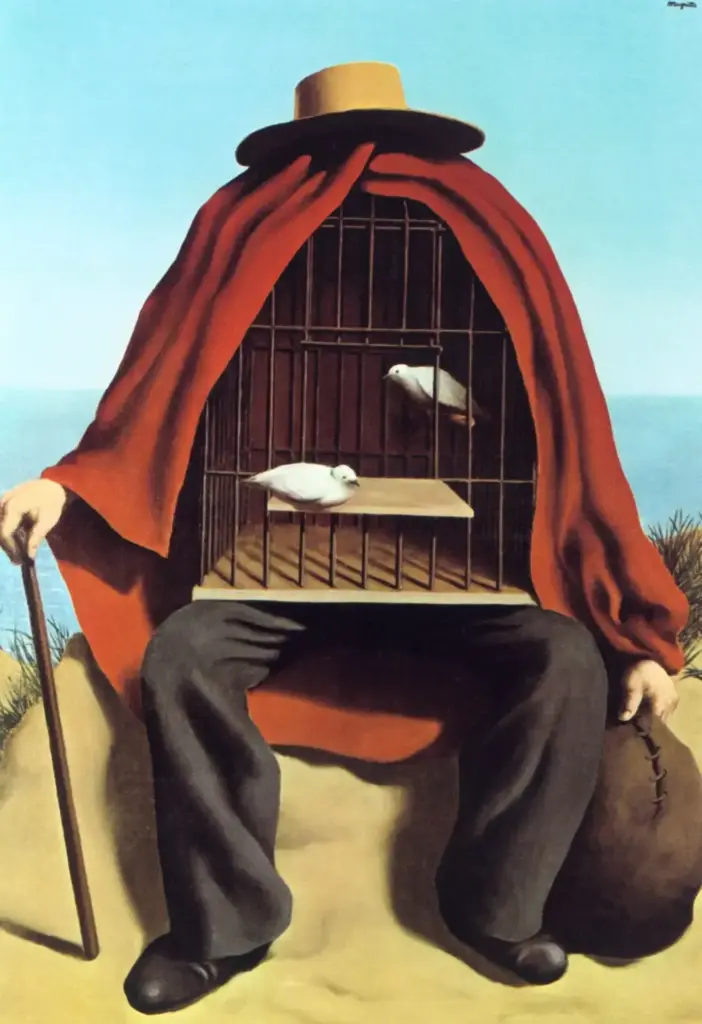
The Therapist (1937)
Magritte did not want to put up with the fact that each of his paintings became the subject of discussion among colleagues, not so much because of its artistic value, but because of the attempts to analyse the artist’s personality. He believed that the people who primarily needed therapy were the psychotherapists themselves (by the way, in the modern world, supervision is a prerequisite for psychotherapeutic practice). The subject of his painting is an excellent illustration of this statement.
Magritte portrayed his “therapist” as a certain wanderer in a wide-brimmed hat, with a crook and a shoulder bag, who is sitting on the edge of a sea cliff. Like many other Magritte’s subjects, he does not have a face, but he opens his cloak wide open, as if allowing the viewer to look into his soul for a moment, opening the veil of his own secret. Hidden under the cloak is a cage with two white doves: one bird inside, behind the closed door, and the other outside. One gets the impression that the free pigeon is trying to communicate with its fellow who is imprisoned in a cage, to support him, to help him get free. So does the therapist helping his clients get out of the dark and lonely place that is within them. Surprisingly, despite his dislike for psychotherapists, Magritte managed to portray the principle of their work very subtly.